
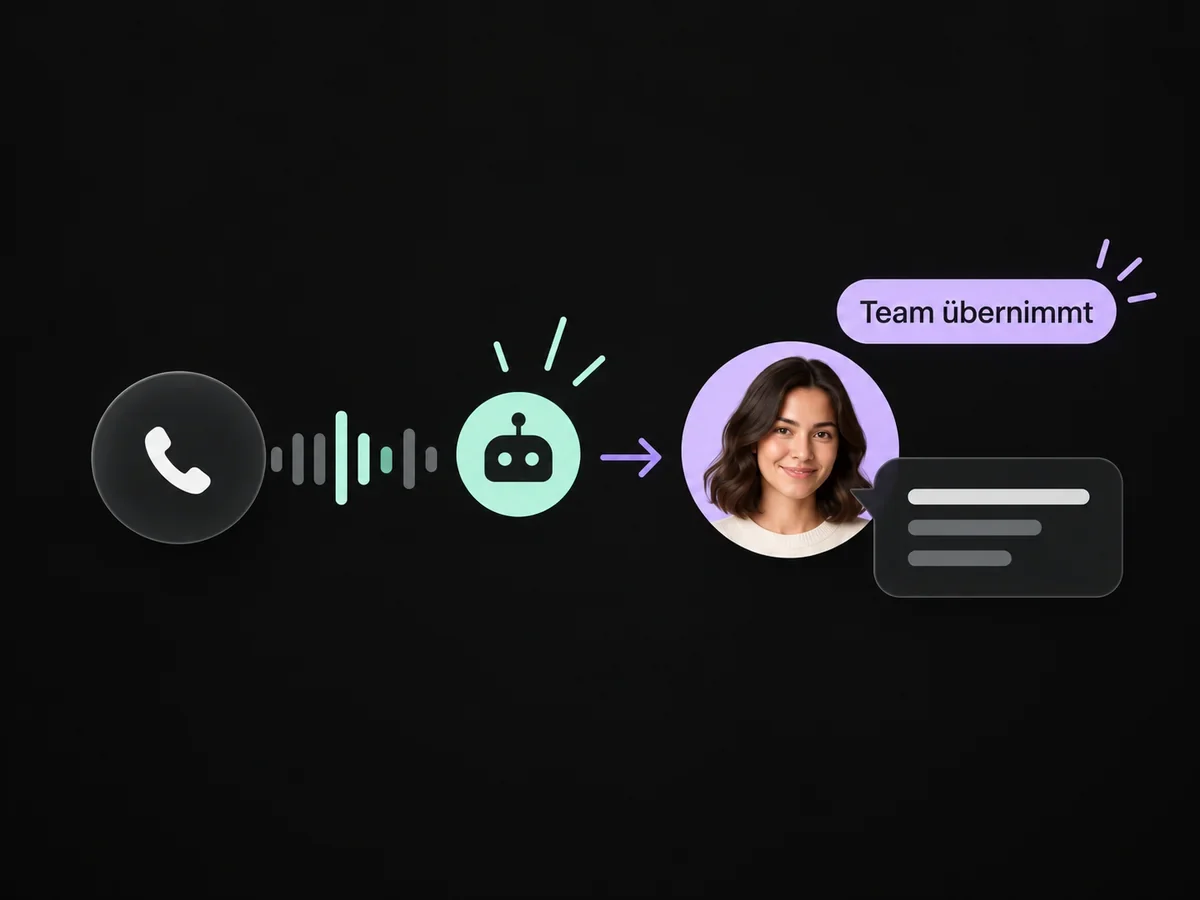
Voice AI
Voice AI human handoff: rules instead of dead ends
Design human handoff as a product feature with triggers, available destinations, context, delivery checks, fallbacks and metrics.
Short answer
A voice agent hands off reliably when it recognises explicit triggers, selects a genuinely available destination, passes confirmed context and checks delivery. If no employee is available, it creates an owned callback instead of implying that a transfer succeeded.
Key takeaways
- Respect a request for a person immediately without repeated questions.
- Separate request, uncertainty, risk and system failure triggers.
- Pass verified details and the open action in structured fields.
- Test live transfer and unavailable-team callbacks separately.
The short answer
A reliable human handoff starts before the transfer attempt. The voice agent must recognise when it should stop, select an available destination, pass structured context and verify that the handoff actually arrived. When nobody is available, the process needs an explicit fallback with a callback task, priority and a realistic expectation for the caller.
Handover is not an automation failure. It is the controlled outcome for calls that require human judgement, empathy, accountability or access.
Human access is part of the product
Reddit questions about voice AI repeatedly come back to one simple request: “Can I speak to a real person?” That is a product question. An agent designed as a closed barrier forces callers into repetition and loops.
A Gartner survey of 3,566 B2B and B2C customers conducted in February and March 2026 provides a clear signal. Eighty-seven percent said access to a human agent was essential when companies use generative AI, while 50% said GenAI makes interactions easier. Neither figure is a voice-AI success rate. Together, they show why automation and reachable people need to be designed as one experience.
AI convenience and human access belong together
Share of customers surveyed by Gartner · Survey conducted in February and March 2026; published 4 August 2026
- Human access essential when GenAI is used87 %
- GenAI makes interactions easier50 %
View data table
| Category | Share of customers surveyed by Gartner |
|---|---|
| Human access essential when GenAI is used | 87 % |
| GenAI makes interactions easier | 50 % |
The values answer different questions and must not be subtracted or read as voice-AI success rates.
Source: Gartner: Customer access to a human agent · Survey conducted in February and March 2026; published 4 August 2026. 3,566 B2B and B2C customers according to Gartner.
Vendor/market-research survey about GenAI in customer service, not specifically telephony or ONE LOOP. The two statements measure different expectations.
Four trigger classes are enough to start
Handoff rules do not need to be maintained as a long list of individual phrases. A first production process can use four trigger classes:
Explicit request: the caller asks for a person.
Uncertainty: intent, identity or a critical detail cannot be confirmed safely.
Risk: a complaint, legal issue, emergency, payment or individual commitment exceeds the agent's authority.
System failure: the calendar, CRM, telephony or another required action has no confirmed result.
The agent states the boundary briefly. It does not repeatedly debate whether the handoff is “really necessary”.
Turn each trigger into a verifiable route
Every trigger needs a destination, availability window and fallback. A sales request can go to sales, an existing order to service and an urgent technical case to an on-call path. One forwarding number for every situation only creates a new queue.
Move from a boundary to confirmed human ownership
Detect the trigger
Classify a request, uncertainty, risk or system failure.
Check the route
Select the destination, availability and suitable fallback.
Connect a person
Transfer live or create an owned callback task.
Confirm context
Record verified details, open action and delivery status.
Destination unavailable or transfer disconnected?
Use the safe fallback and never imply that an unsuccessful handoff was completed.
Recommended ONE LOOP handoff logic; test destination teams and failure paths before launch.
Live transfer or callback
A live transfer is appropriate when the destination team is genuinely available and can continue the case. Outside that window, a structured callback is better than prolonged ringing. The agent communicates the approved response window rather than making an unrealistic promise.
Situation | Primary path | Fallback |
|---|---|---|
Person explicitly requested | connect to an available team | prioritised callback task |
Critical detail unclear | specialised member of staff | mark data as unconfirmed |
Sensitive or emotional case | named owner | provide a safe contact alternative |
System action failed | technical or operational queue | never claim success |
A context package prevents repetition
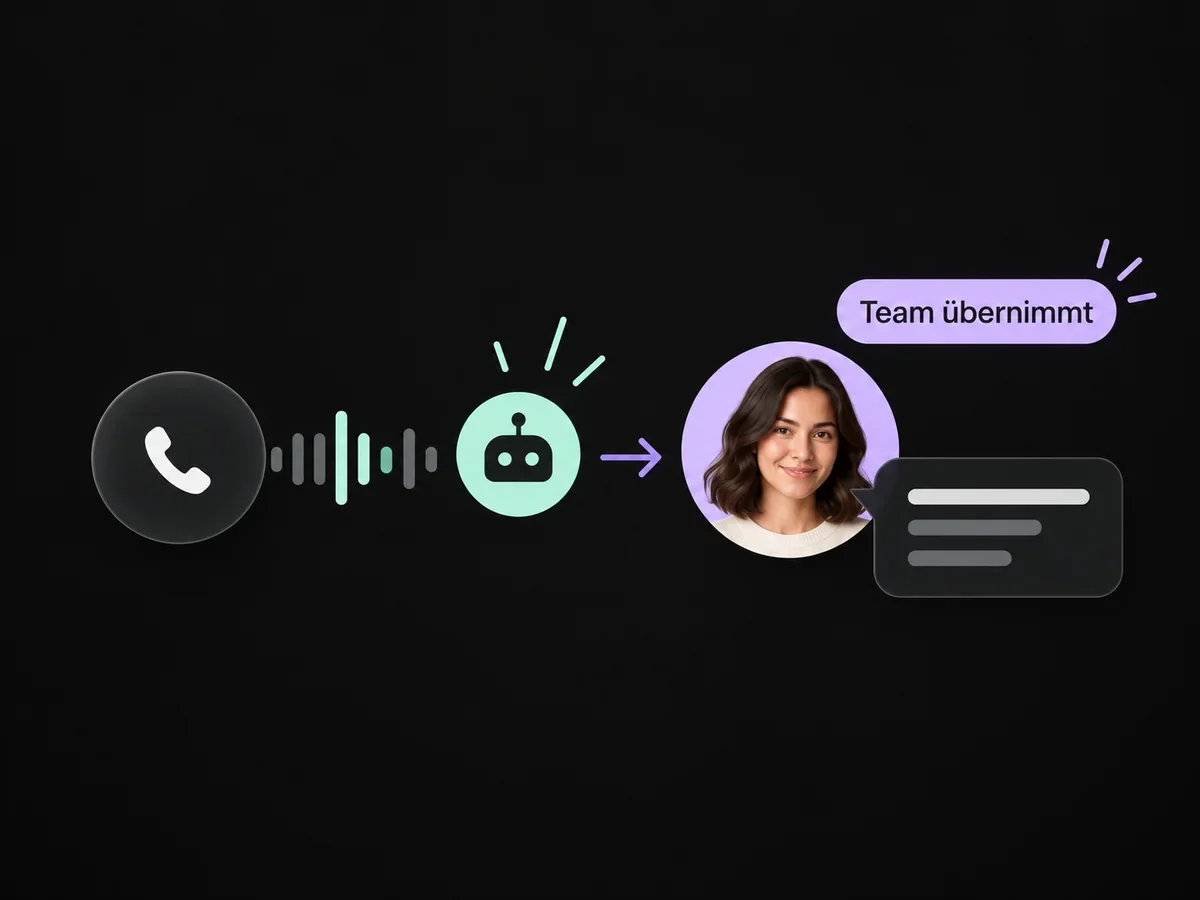
After a poor handoff, the customer has to explain the entire issue again. A good handoff passes only the necessary information: identified call reason, confirmed contact details, points already resolved, open next step, urgency and reason for transfer. A free-form model summary is not treated as verified fact.
The receiving employee should be able to distinguish confirmed statements, agent interpretation and missing information. Defined fields are more useful than a long paragraph for this purpose. A transcript may provide additional context where its processing is permitted, but it does not replace a structured handoff.
Delivery needs technical confirmation
“Transfer initiated” is not the same as “employee reached”. The process needs states such as answered, unanswered, busy, out of hours and technical failure. The next action for each state is decided before launch.
If a live transfer fails, the call must not simply end. Where technically possible, the agent returns to the caller, confirms the callback number and creates a task. If that cannot be done reliably, it gives an alternative contact path without claiming success.
Define availability and ownership
A handoff can only be as good as the team behind it. Service hours, ring groups, cover arrangements, priorities and response objectives belong in the same operating description as the agent. An “urgent” label without a responsible person is only a label.
Callback work is assigned to an owner rather than an anonymous list. The task has a due time and escalation. When the promised window is missed, the failure becomes visible instead of remaining an unnoticed open record.
Metrics that reveal quality
Handoff rate alone is neither good nor bad. A high rate may indicate an agent with too little authority, while a low rate may conceal ignored customer requests. Review several outcomes instead:
explicit handoff requests respected immediately
successful live transfers per genuinely available destination
callbacks completed within the promised window
conversations where customers had to repeat the issue after transfer
failed transfers without a follow-up task
critical calls the agent incorrectly continued handling
Keep the denominator next to every metric. “90% transfer success” is meaningless when abandoned or out-of-hours calls are excluded without explanation.
Test the handoff, not just the happy path
Tests should include more than a polite request for an employee. Callers interrupt, change intent, name the wrong department, call outside service hours or ask again after several AI responses. Also simulate a busy destination, no answer, disconnection during transfer and a failure while writing the callback task.
After every test, compare the conversation with the actual system state. The agent must not say “I have passed everything on” when it merely dialled a number.
How ONE LOOP configures handover
ONE LOOP defines triggers and destinations before conversation wording. Every destination receives an availability window, fallback and owner. The context package uses explicit fields. The agent is expanded to more call reasons only after live transfer and callback work under realistic failure conditions.
Conclusion
People are not an undefined emergency exit at the end of the flow. They are a designed part of the system. A good voice agent recognises its boundary, hands over without resistance, passes confirmed context and checks the outcome. That is what makes automation reliable for customers.
FAQ