
Voice AI
Voice agent knowledge bases: reliable answers on the phone
Maintain business knowledge for your telephone assistant with knowledge cards, clear approvals, current sources and separate retrieval and conversation tests.
Short answer
A voice agent knowledge base holds approved answers to a defined set of customer questions. Keep lasting business information, current system data and conversational authority separate. Every answer needs an owner, a valid version and a fallback when information is uncertain. Then test both knowledge retrieval and the answer the caller actually hears.
Key takeaways
- Reference knowledge, current system access and conversational authority are different responsibilities.
- Every answer needs an authoritative version and an accountable subject owner.
- Correct retrieval does not prove that the spoken answer is correct.
- Evaluate answerable questions separately from deliberately bounded fallbacks.
Why reading a website does not establish the right answer
Consider a fictional building maintenance business. Its website offers maintenance visits by arrangement. A caller asks, “Can you come this Saturday?” That page describes a service, not an available appointment or a staffed Saturday. A friendly confirmation would therefore go beyond the evidence.
Finding relevant information is also a problem in general self-service. Gartner reported in 2024 that customers could not find relevant content in 43% of self-service failure cases. Its December 2023 survey covered 5,728 customers overall; the subgroup size is not disclosed. This provides historical service context, not an error rate for today's voice agents. Gartner's original release
Relevant information could not be found
Share of reported self-service failure cases · Survey Dec. 2023 · published 19 Aug. 2024
- Could not find content relevant to the issue43 %
View data table
| Category | Share of reported self-service failure cases |
|---|---|
| Could not find content relevant to the issue | 43 % |
Historical service context, not a voice AI error rate.
Source: Gartner · Self-service survey · Survey Dec. 2023 · published 19 Aug. 2024. Overall survey: 5,728 customers. Size of this subgroup not disclosed.
Not a Germany-specific result or a knowledge-base impact study. One value on a 0–100% scale.
Our recommendation is to start with the questions your telephone assistant should answer. Give each one a substantiated answer or a deliberately limited next step. The number of imported pages is not a useful success measure for that work.
What belongs in the knowledge base, and what does not?
A knowledge base provides reference information. A calendar connection checks a current state. Conversation rules establish how the assistant may use either. These functions need different maintenance and tests.
Information | Recommended place | Boundary |
|---|---|---|
Services, service area and required documents | Approved reference source | Describe only services actually offered |
General opening hours and dated exceptions | Maintained operating information | Staffed hours do not establish appointment availability |
Available appointments or case status | Authorised access to the current system | No current commitment without a successful lookup |
Approved public price and its conditions | Versioned pricing source | Do not invent individual discounts or surcharges |
Tone, clarifying questions and permitted handoffs | The assistant's conversation rules | Not a substitute for missing facts |
Passwords, internal notes and other customers' data | Excluded from the generally accessible knowledge base | Enforce access rights outside the conversation prompt |
Verify the availability of current system access in the selected setup. Calling an imported table a knowledge base does not make it live. Customer-specific information also needs a separately reviewed access path.
A knowledge card your team can maintain
Create a short card for each coherent answer. Alternative phrasings of the same question belong on that card; separate copies can drift apart. The following is our suggested working template, not an assumed software screen.
Field | Example for the fictional maintenance business |
|---|---|
Reference and customer question | W-017: “Do you work on Saturdays?” |
Other phrasings | “Can you come at the weekend?”; “Is anyone there on Saturday?” |
Approved answer | Saturday appointments require individual review; no blanket commitment |
Scope | Maintenance enquiries; no statement about an emergency service |
Authoritative source | Saturday appointment policy approved by the scheduling lead |
Owner and version | Scheduling lead; version reference, effective date and next review date |
Permitted next step | Capture the request for review; do not confirm an appointment |
Language approval and test cases | German and English versions; questions with and without a specific date |
Make the answer understandable when spoken: one point, its necessary condition and, where appropriate, a clarifying question. For example: “We review Saturday appointments individually. Which date would you like the maintenance visit?” Creating a callback task afterwards is a separate action to verify.
A price needs its service scope, currency, tax treatment and validity alongside it. Do not separate a number from its conditions. If each job requires an individual quotation, that is the approved answer.
Select sources, import them and check the intended agent
Start with a bounded responsibility, such as general maintenance enquiries. Choose one authoritative source for each fact. A maintained website section may work well; old proposal PDFs, campaign pages and internal drafts must not contradict it unnoticed.
Collect approved questions and mark missing answers. Unknown information remains unknown for now.
Select specific pages or document sections. For PDFs and tables, check that headings, rows and conditions remain connected after import.
Inspect the content actually extracted. A successful import status does not prove that all text was captured correctly.
Connect the reviewed knowledge base to the intended agent. After saving, check that this particular agent uses the new version.
Test retrieval and the telephone conversation separately. Only then release the affected scope for customer calls.
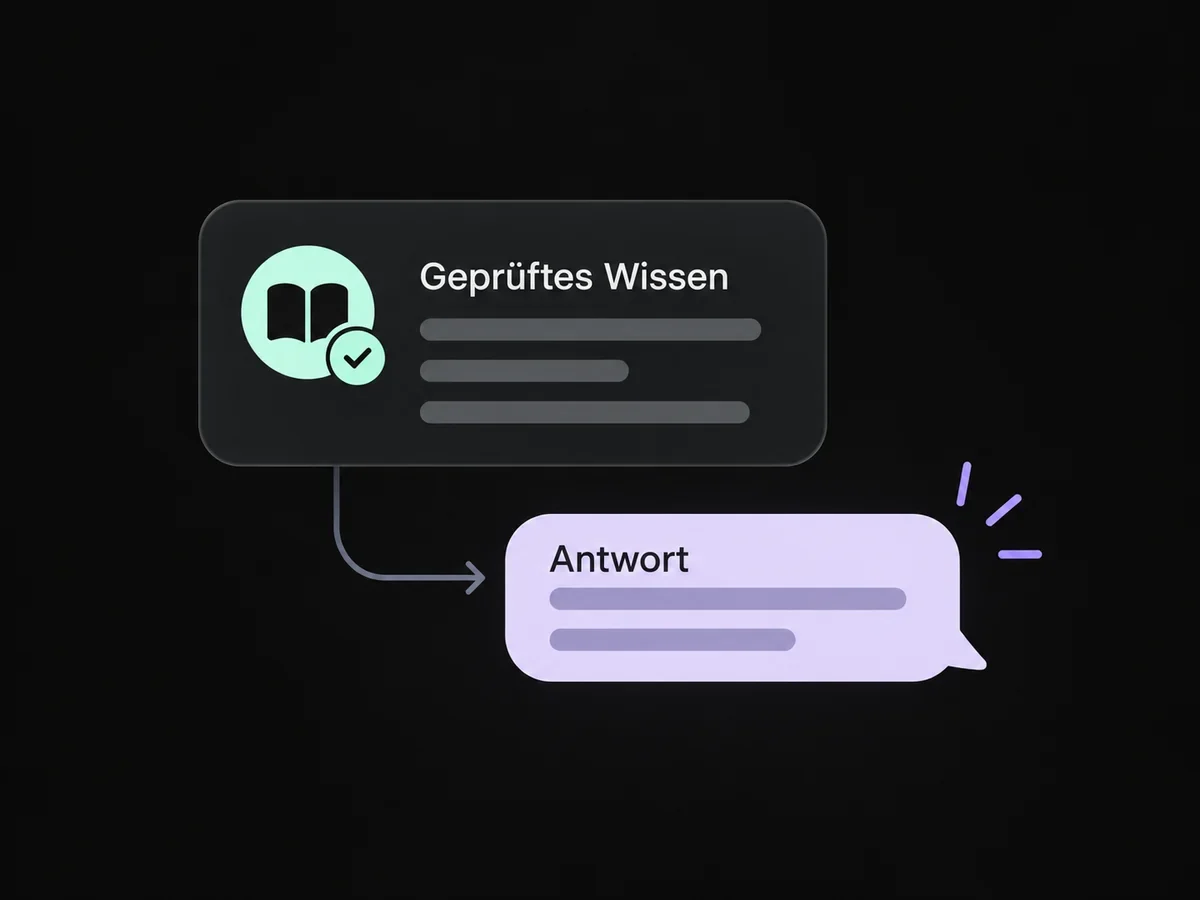
From source to a verified spoken answer
Select the source
Choose one authoritative version for each fact; exclude old documents and information not permitted for callers.
Approve the answer
The subject owner confirms the answer, validity, conditions and permitted next step.
Check retrieval
On the intended agent, check that different customer phrasings retrieve the right information.
Test the call
Check spoken answers, follow-ups and boundaries in both languages before releasing the scope.
Source unclear, answer wrong or authority exceeded?
Restrict the affected answer, assign the cause and retest after correction; do not invent a commitment.
Recommended approval path: review factual accuracy, retrieval and spoken behaviour separately.
When a website supplies the knowledge, make the lasting correction in the authoritative source. Check whether later imports replace intermediate edits. For an urgent error, the affected answer can be restricted to human clarification until the update is confirmed.
Three checks: found, said correctly and permitted
1. Did retrieval find the right information?
Test the specific question using several natural phrasings. Does the result match the service, location and current version? A similar keyword is insufficient. Information about new installations must not answer a maintenance question simply because both contain the word “appointment”.
If the system does not expose retrieval results, record that verification limit. Use controlled questions and the visible conversation; do not claim to have proven an internal retrieval step you cannot inspect.
2. Did the agent use the information correctly?
Ask the question through the intended telephone channel. Can you hear the crucial qualification? Does it survive a follow-up question? In the Saturday example, “requires review” must still apply when the caller asks, “So my appointment is confirmed now?”
If retrieval finds the right content but the spoken answer is wrong, another copy of the document is not necessarily the fix. First investigate conflicting conversation rules, unnecessarily long answers and missing conditions. Change one likely cause per test run where possible, then repeat the unchanged test cases too.
3. Was the statement or action permitted?
The fact that a business provides maintenance does not permit a booking without a confirmed slot. An internal note does not become an authorised customer answer merely because it is retrievable.
A knowledge base provides answers. It does not grant authority.
OWASP explains that content from files or websites can also influence a model in unintended ways. Our design implication is to restrict approval and system permissions independently of retrieved text. A sentence in a prompt is not a dependable access-control mechanism. OWASP: Prompt Injection
Changes and knowledge gaps need an owner
Treat a new question as a review task first, not an automatic addition. A caller's statement is not an approved company policy. Record the question without unnecessary personal information and distinguish missing knowledge, outdated content, wrong retrieval and incorrect use of a correct result.
The responsible subject specialist confirms the answer. Update the authoritative source, import the change and test it in conversation. Keep previous versions in a separate archive, not alongside current content in active retrieval. Prioritise recurring questions by operational importance; one incorrect price commitment may warrant attention sooner than many harmless phrasing preferences.
This aligns with KCS, which integrates knowledge capture, reuse and improvement into everyday work. The method should not be confused with the tool used to support it. Consortium for Service Innovation
Following a faulty change, restore a previously tested version only if it remains factually valid. Otherwise keep the affected answer restricted. The version and time of the change also help identify potentially incorrect commitments for human review.
German and English must make the same commitment
Link both language versions through the same knowledge reference and subject-matter approval. Translate conditions, exclusions and next steps as well as the main sentence. “By arrangement” must not become unrestricted availability in the other language.
Recheck both versions after a change. If a translation is pending, the old statement must not continue unnoticed in that language. Use the restriction or handoff route already tested in the setup. Also test switching languages during a conversation: the language may change, but the agent's authority does not.
A small test plan with meaningful results
Prepare cases with expected behaviour established in advance. Use fictional test identities rather than real confidential customer records. Document the knowledge version, language, question, actual response and outcome separately.
Test case | Expected behaviour |
|---|---|
Standard question and a conversational variant | Same substance, appropriate wording |
Request outside the service area | State the boundary; do not invent coverage |
Unknown service | Acknowledge uncertainty and offer the permitted clarification path |
Conflicting old and new prices | Resolve the conflict before release; no price commitment meanwhile |
Specific appointment without a successful calendar lookup | Do not confirm a booking |
Follow-up asking for an unauthorised commitment | Preserve the qualification |
Switch between German and English | Keep conditions and next steps equivalent |
Measure answerable questions separately from deliberately unanswerable cases. Otherwise, an overly cautious assistant that passes everything to a person may appear as successful as one that actually helps.
An explicitly fictional calculation: 17 of 20 answerable test questions receive correct answers, or 85%. Five additional unknown questions are correctly referred for clarification. Those five belong in the fallback evaluation, not the answer-quality denominator. Report false commitments and unauthorised disclosures as individual failures too. This test percentage is not a prediction of production performance.
Getting started with ONE LOOP
Choose a manageable set of questions and name the person who approves the answers. Create the knowledge cards, verify the source and action access actually available, and test the complete workflow. This guide describes a recommended operating model; it does not promise automatic refresh or knowledge-gap detection in every setup.
Questions the assistant cannot resolve need a handoff to a person. The voice AI checklist for Germany covers the separate operating requirements. To establish which answers and actions your assistant should handle, discuss your telephone workflow with us.
FAQ