
Lead Management
Lead qualification: ask the next right question
Build lead qualification as an explainable decision process: ask only the next necessary question, retain uncertainty and evidence one owned next step.
Short answer
Design lead qualification backwards from the next operating decision. At first contact, ask only for a safe return path and the hard service boundaries that actually change the next step. Then ask just the next unknown decision question, based on the answers already held. Store person-level data on the contact and case-specific data on the opportunity; keep `unknown`, `unanswered`, `invalid` and `no` distinct. A single misclick or soft signal must never reject a lead permanently. The process ends only when it has an explainable qualification state and exactly one owned next action.
Key takeaways
- Design every qualification question backwards from a named operating decision; fields without an effect do not belong in first contact.
- Separate contact and case data, and keep unknown, unanswered, invalid and no distinct so stale or missing values cannot create a false rejection.
- Use five operating states and route misclicks, free-text uncertainty or contradictory answers to correction or human review.
- Complete the process only when exactly one task, appointment, service route or review card has an owner and due time in the destination system.
Qualification is a decision about the next step
“Qualified” can sound like a judgement about a person. In a dependable process it is merely an operating state: are the currently confirmed facts sufficient to give this specific request the appropriate next step?
A fictional heating company might need a postcode, type of problem and reachable return channel before offering a site visit. Exact spending intent could be discussed later. A consultancy with several services may first need to distinguish a new project from support or an existing customer relationship. Both companies qualify leads, but their decisions, questions and safe outcomes are different.
Good qualification does not collect the greatest amount of data. It asks the smallest question whose answer genuinely changes the next operating step.
Qualitative discussions among small-business owners and automation users surface recurring friction: one mistaken click can reject an enquiry immediately, workflows grow with every exception, and many CRM fields never inform a subsequent decision. These accounts provide useful edge cases, not a general success rate. ONE LOOP therefore needs to make its own business decisions explicit instead of copying somebody else's question list.
Start with the decision, not the form
Every question receives an operating purpose first. If nobody can explain which route, preparation or action an answer changes, the question does not belong in first contact.
A small decision register is enough to begin:
Field | Example | Why it is needed |
|---|---|---|
next decision | callback, appointment, human review or service route | prevents data collection without a consequence |
exact question | “Where will the service be delivered?” | makes wording testable |
answer source | form, conversation, confirmed CRM value or import | separates assertion, observation and confirmation |
answer type | choice, number, date or short free text | enables appropriate validation |
destination object | contact or opportunity | prevents case data becoming a permanent trait of the person |
required now? | yes, no or only after a specific answer | removes unnecessary first-contact fields |
validity | permanent, until a date or for this case only | protects decisions from stale data |
permitted states | unknown, valid, invalid or contradictory | preserves uncertainty visibly |
fallback | next question, human review or a safe default route | prevents silent rejection |
owner | role and response deadline | makes an open decision actionable |
The design direction is reversed: not “Which fields could we add?”, but “Which decision is next, what is genuinely missing and who owns the outcome?”
Three information layers keep first contact light
Not every item is equally urgent. A robust qualification process separates three layers and keeps prioritisation or later lead scoring outside this model.
Layer | Typical information | When to ask | What it may change |
|---|---|---|---|
1. contact and reply ability | name or reference, confirmable return path, specific request | as early as necessary | preserve the event and permit a reply |
2. hard service boundary | service area, available service, mandatory technical requirement | before selecting an unsuitable appointment or owner | choose the eligible path, service notice or review |
3. case preparation | timing, scope, current system, relevant documents | progressively after basic fit is confirmed | prepare the conversation or appointment |
Budget, urgency or company size can be hard boundaries in some business models. Elsewhere they change only preparation or priority. The field name does not decide which; the written operating rule does.
A question must not be mandatory simply because it could be useful later. If a form captures ten values but only email and region change the immediate step, the other eight should be optional, deferred or removed.
Keep the contact and the business case separate
The same person may have a support question today and a new buying enquiry next month. Phone and preferred language may belong to the contact; budget, timeline, project location and requested service usually belong to the specific case.
Object | Suitable content | Critical mistake |
|---|---|---|
contact | confirmed email, phone, name, language and communication state | storing one project's budget as a permanent property of the person |
business case | need, service location, scope, timeline and qualification state | overwriting a new request inside an old opportunity |
question event | question shown, available options, timestamp and channel | retaining only the latest value so a misclick cannot be reconstructed |
next action | owner, activity, due time and result | setting “qualified” without anybody owning the next step |
Current systems may handle contact and opportunity fields differently. Not every form type writes to every object in the same way. Before a pilot, verify where each field is stored, which intake can change it and what a repeat submission updates. A value valid for the current case must not silently control every future enquiry from the same person.
A hard rule, priority signal and context are different things
Many broken qualification journeys result from treating every attribute as an exclusion rule.
Rule type | Example | Permitted effect | Protection |
|---|---|---|---|
hard service boundary | confirmed location outside the service area | choose an appropriate alternative or not-fit route | value must be unambiguous, current and correctable |
priority signal | requested start “as soon as possible” | affect ordering among otherwise eligible cases | no final rejection and no invented urgency |
preparation context | current software or team size | prepare the conversation and materials | do not ask again when a valid answer exists |
soft model output | free-text classification or inferred intent | support human review | never cause irreversible rejection by itself |
An incomplete postcode is not “outside the service area”. A blank budget field is not “no budget”. A model that assigns uncertain free text to a category has not proved that the business cannot help. The data state must preserve these distinctions.
Five states are enough for a clear first pilot
A single `qualified = yes/no` field hides too much. Five operating states are sufficient for a manageable process:
State | Meaning | Next step |
|---|---|---|
fit and ready | hard boundaries confirmed and necessary details present | let an eligible owner accept an appointment or sales step |
fit, information missing | basic fit confirmed but exactly one decision is open | ask only the next missing question |
human review | answer contradictory, uncertain, sensitive or rule-critical | create one review card with reason, owner and due time |
not a fit now | a confirmed hard boundary is not met | explain respectfully and offer a permitted alternative or later return |
existing customer / service route | the request is not a new sales opportunity | move it into the appropriate service or account process |
`Unknown`, `unanswered`, `invalid` and `no` remain distinct data states underneath. Skipping an optional field is not a refusal. A malformed phone number is not a rejection. An unknown region needs clarification, not an automatic not-fit state.
“Not a fit now” must not delete the contact or original request either. Store the rule version, confirmed reason and offered outcome. A corrected answer or changed service can then be re-evaluated later without rewriting history.
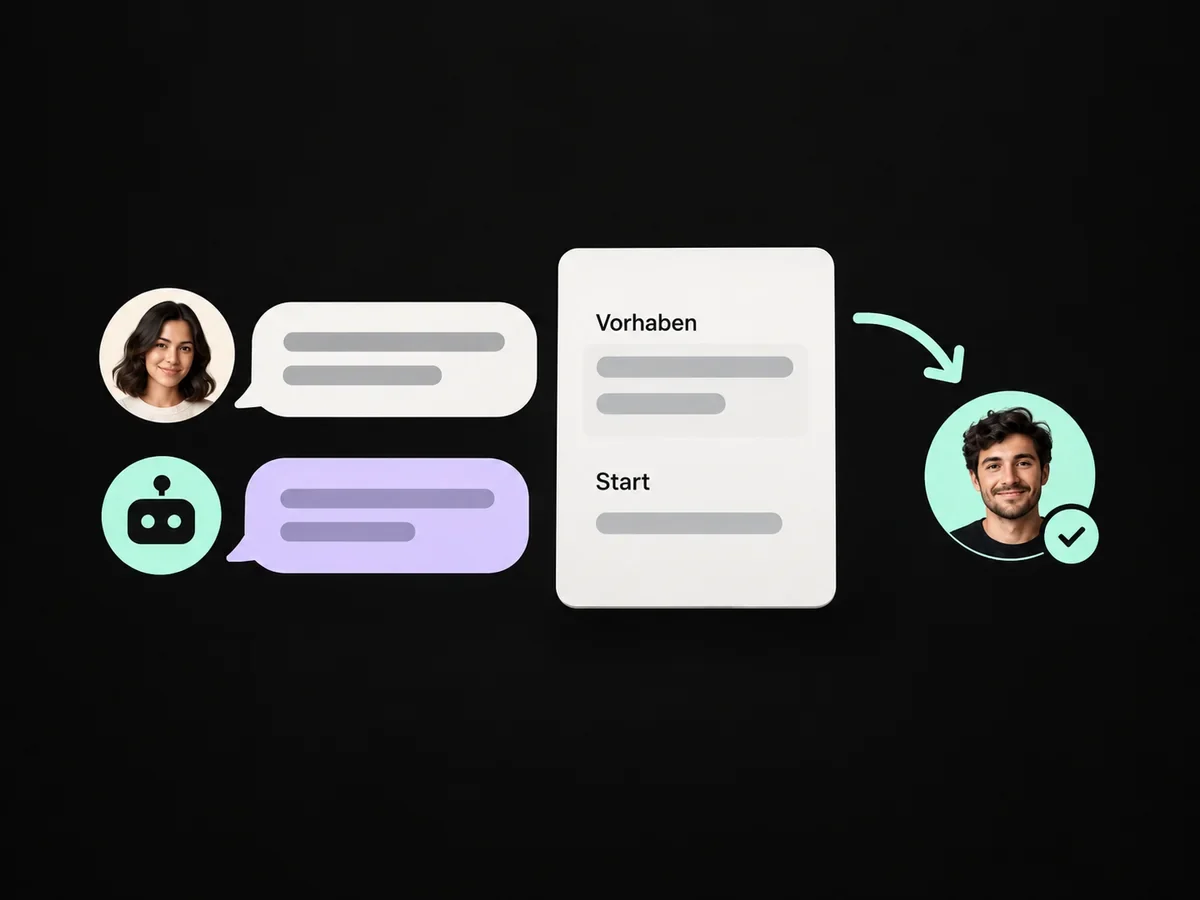
From an enquiry to one owned next action
From an enquiry to one owned next action
Preserve the need
Keep the unique event, specific request, channel and existing confirmed contact values.
Choose the next question
Derive the one unknown value that changes the outcome from the next open operating decision.
Form the state
Check answer type, validity and conflicts; stop misclicks, free-text uncertainty and critical contradictions.
Evidence the action
Read an appointment, task, service handoff or review card back with exactly one owner and due time.
Answer invalid, conflicting or uncertain, critical exclusion inferred only from a soft signal, or an API update bypassed a required check?
Do not reject silently or guess. Preserve the raw answer, offer correction and create a review card with reason, owner and due time.
Recommended flow: preserve the need and return path, ask only the next decision question, stop uncertainty visibly and confirm exactly one next step.
1. Preserve the need and a safe return path
Secure the unique event, specific need, channel and any confirmed contact values. Link the enquiry to the correct contact while retaining it as a separate business case. Do not ask again for a known valid value.
2. Select the next decision question
Read the next open business decision and question register. Select exactly the unknown question whose answer changes the next step. Conditional paths reveal only relevant fields; they do not create every imaginable branch in advance.
3. Form a state or stop visibly
Check answer type, validity, origin and contradictions. A confirmed hard boundary may determine a clear state. Invalid format, free-text uncertainty, critical conflict or a possible misclick goes to correction or human review, not silent rejection.
4. Evidence exactly one next step
Create an appointment, task, service handoff or review card with exactly one owner and due time. Then read the destination system back to confirm that qualification state, case, owner and action agree. Only then is the run complete.
Questions must be understandable and correctable
A useful business question can still fail in its interface. The W3C WAI guidance on labelling form controls recommends understandable visible labels and an explicit technical association with the input. This supports not only screen-reader users but also people using small screens, magnification or a form under time pressure.
The W3C WAI guidance on input validation covers visible required states, appropriate input types, understandable error messages and the ability to review and correct critical details. Client-side checks improve the interaction; server-side validation is still necessary.
For qualification, that produces practical rules:
Write in customer language and explain briefly why the question is needed now.
Show required status and expected format before submission.
Use choices only when the set is sufficiently complete; offer `other` or human clarification.
Accept plausible formats and separate formatting failure from a substantive “no”.
Let a person confirm or correct a critical exclusion answer.
Do not ask repeatedly for a confirmed value that remains valid.
Do not hide rejection behind a generic success message.
Progressive qualification is therefore more than hiding fields. It is state-aware: the system knows what is already known, why the next question appears and which safe outcome is permitted after each answer.
What the external form analysis shows — and what it does not
Formidable analysed a preselected set of B2B domains for The State of Inbound 2026. Its read-only crawl ran on 28 and 29 August 2026. After removing nine obvious parsing failures, the working set contained 7,519 rendered forms and 47,700 fields.
The published absolute counts can be grouped into three bands: 3,447 forms had zero to three required fields, 3,631 had four to eight and 441 had nine or more. Those groups represent 45.8%, 48.3% and 5.9% of the analysed set.
Required-field counts across 7,519 rendered B2B forms
Share of the analysed form set · Read-only crawl 28–29 August 2026
- 0–3 required fields45.8 %
- 4–8 required fields48.3 %
- 9 or more required fields5.9 %
View data table
| Category | Share of the analysed form set |
|---|---|
| 0–3 required fields | 45.8 % |
| 4–8 required fields | 48.3 % |
| 9 or more required fields | 5.9 % |
Grouped from published absolute frequencies; observed form structure, not a measure of completion, conversion or lead quality.
Source: Formidable · The State of Inbound 2026 · Read-only crawl 28–29 August 2026. 7,519 rendered forms in a preselected corpus of B2B domains, after removing nine obvious parsing failures.
0–3: 3,447; 4–8: 3,631; 9+: 441. Non-random technographic, portfolio and intent sample; JavaScript and iframe limitations; direct vendor interest. Not representative of German SMEs and not evidence of an optimal field count, conversion, lead quality or ONE LOOP performance. Scale 0–100%.
This distribution is not a test of optimal form length. No form was submitted. The report therefore does not measure completion, conversion, lead quality, response speed or revenue. Some one-field forms may be newsletters, while JavaScript or iframe forms may fail to render.
Nor is the sample a market cross-section. It came from five named technographic, VC-portfolio, intent and internal lists and was prefiltered for companies with particular signals. Formidable sells a conversation-based inbound product and has a commercial interest. The chart therefore shows only that this observed corpus contained a broad spread of required-field counts. It does not support exactly three questions, a conversion effect for German SMEs or any ONE LOOP performance claim.
The useful internal test does not compare arbitrary field totals. It evaluates each question: was it displayed, understood, answered validly and actually used in a decision?
Privacy and currency belong in the model
The principles in GDPR Article 5 include purpose limitation, data minimisation and accuracy. They do not produce a universal qualification list, and this article is not legal advice. They do support a clear operating rule: request data for a named purpose, keep origin and validity visible, and make inaccurate data correctable.
A project budget from 2024 must not be treated as a current personal attribute in 2026 without review. An inferred industry is not as dependable as a confirmed selection. An answer valid for one site must not govern every location of the organisation. Retention, deletion, lawful basis and channel permission need approval from the responsible function before launch.
Partial failure must not create a second decision
A workflow can save an answer and then fail while creating the task. A person can correct the choice at the same moment. Or an API update can write a value even though the user interface would have required a related field. A blind restart risks a second case or contradictory state.
Recovery reads first:
Has the technical event already been preserved?
Which question and version were actually shown?
Which raw and validated answer exists?
Was the answer corrected later or replaced through another channel?
Which qualification state and rule version are current?
Does an owner, appointment, service case or review card already exist?
Which single action is actually missing?
An invalid answer is not converted into a substantive no. An existing review card is not created again. When a corrected answer has produced a new state, the old path must not send another message. Technical success becomes complete only after the operating state is read back.
Twelve tests before the pilot
The following cases are fictional system tests, not measured ONE LOOP outcomes.
Test case | Required evidence |
|---|---|
person accidentally selects “outside service area” and corrects it | corrected answer wins; no permanent rejection or parallel message |
postcode remains unknown | `information missing` state; exactly one clarification step with owner or return path |
address sits on the service-area boundary | visible rule version or human review instead of a guessed route |
same contact has two projects with different budget and timing | one contact, two cases, each with its own qualification state |
returning person has confirmed contact details | no repeated request for the same valid return channel |
existing customer enters the sales form | service route rather than a new sales cadence; original event retained |
email invalid but phone confirmed | operating fit remains open; return path and error state stay separate |
`other` selection includes understandable free text | human review or an appropriate new category, not automatic rejection |
budget band is ambiguous | clarification or context, not an automatic `no budget` value |
optional field remains blank | `unanswered`, not `no`, and no exclusion |
API update bypasses a field required by the interface | server-side process check stops before final decision |
same form event is delivered again | one enquiry, one current state and exactly one next action |
A case passes only when contact, business case, answer state, qualification state and next action agree in the destination system. A green workflow run or a populated field is insufficient.
Metrics should measure decision quality, not data volume
Define numerator, denominator and review period before the pilot. Keep absolute counts next to percentages, especially at small volumes.
Metric | Numerator | Denominator |
|---|---|---|
question exposure | cases shown a specific question | all cases eligible to see that question under the rule |
valid answer rate | valid answers to the displayed question | all exposures of that question |
decision coverage | cases with sufficient confirmed values for a next step | all uniquely processed pilot cases |
clarification rate | cases reviewed because an answer was missing, conflicting or uncertain | all cases reaching that decision |
correction rate | answers changed before the final state | all submitted answers to critical questions |
repeated-question rate | cases asked for a confirmed value that remained valid | all cases already holding that valid value |
review confirmation | human reviews confirming the proposed state | all completed operating reviews |
false-negative audit | sampled cases incorrectly confirmed as not fit | all audited not-fit cases |
acceptance rate | qualified or review cases with a confirmed owner and due time | all cases requiring human action |
orphaned next steps | due cases without exactly one responsible owner | all cases due at the measurement point |
A higher answer rate is not success if more people are rejected incorrectly. A high qualification rate is not a goal by itself either; it can reflect overly permissive rules. The objective is to give the right case the right next step while keeping uncertainty visible.
How ONE LOOP runs a bounded pilot
Start with one intake route, one service and no more than two hard operating decisions. Record the existing contact and opportunity fields, permitted answer types and expiry in the question register. Define the five states, the human-review route and exactly one next action for each outcome.
ONE LOOP can use structured contact and opportunity fields, conditional question paths, workflow branches, tasks, assignment and opportunity states. Exact availability depends on the form or survey type and destination object. Conditional rule order, new or cloned versions, API and workflow updates, and movement between accounts therefore need specific testing. Automation does not prove the truth or currency of an answer.
Build the twelve fictional cases first, read every result back in the CRM and then start with a bounded number of real enquiries. Audit not-fit outcomes regularly. Add another question only when it demonstrably improves a decision rather than merely adding a field.
Connect a website form to CRM covers technical intake protection. Distribute leads fairly begins once a case is routable. Respond to leads after hours explains the honest handover outside opening hours. ONE LOOP can then design the qualification pilot with you.
Conclusion
Good lead qualification is neither a long form nor a hard yes/no gate. It starts with the next operating decision, asks only the missing question and retains uncertainty as a real state. Contact and business case stay separate; hard boundaries, priority and preparation have different effects. Critical answers are correctable, soft signals cannot cause irreversible rejection, and each outcome ends with exactly one owner and due next action. That turns data collection into an explainable customer process.
FAQ